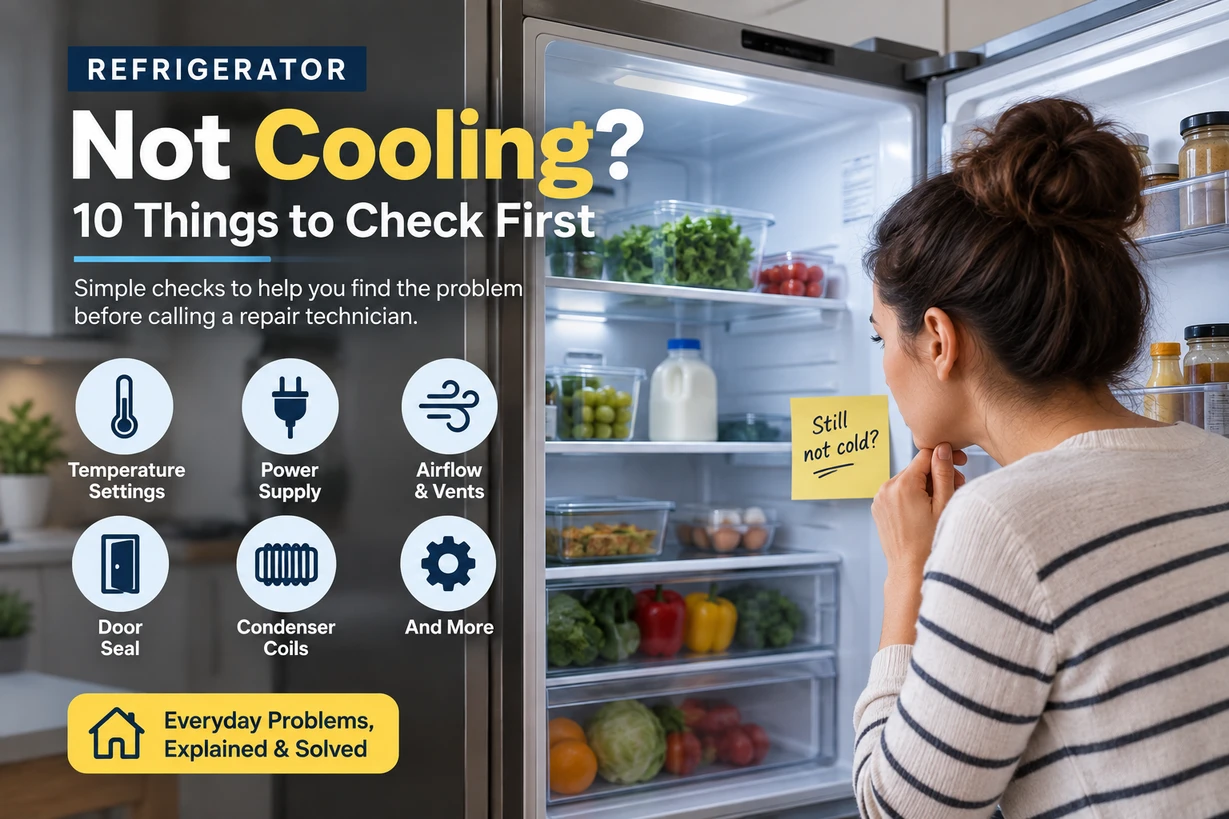
If your refrigerator is not cooling properly, you may notice warm drinks, soft butter, spoiled food, or a freezer that still seems to work while the refrigerator compartment feels too warm.
The problem could be something simple, such as a blocked air vent or an incorrect temperature setting. It could also involve a fan, a door seal, or a component that needs professional attention.
Before assuming your refrigerator is broken, work through these checks in order. They can help you identify common issues and decide when it is time to call an appliance technician.
1. Check the Refrigerator Temperature Settings
Start with the temperature controls. Someone may have accidentally changed the settings while cleaning, loading groceries, or adjusting shelves.
For many refrigerators, a common recommended starting point is:
- Refrigerator compartment: 37°F (about 3°C)
- Freezer compartment: 0°F (about -18°C)
These are general targets, not universal settings. Follow your refrigerator’s owner’s manual if it specifies different recommendations.
If the temperature setting was recently changed, return it to the recommended setting and allow time for the refrigerator to stabilize. Avoid repeatedly adjusting the controls, because the appliance may need several hours to respond.
What to do: Check the display or temperature dial and confirm that the cooling setting has not been turned off or changed.
2. Make Sure the Refrigerator Has Power
A refrigerator may appear to be running even when it is not receiving power consistently. Check whether the interior light, display, or other normal indicators are working.
Look for these signs:
- The interior light does not turn on.
- The display is blank.
- The refrigerator is completely silent when it would normally make some operating noise.
- The appliance has recently lost power or experienced an electrical interruption.
If the refrigerator has no power, check whether the plug is securely connected and whether the household circuit breaker has tripped.
Safety note: Do not use a damaged cord, handle exposed wiring, or remove electrical panels. If the outlet or wiring appears damaged, stop and contact a qualified electrician or appliance technician.
3. Check Whether Food Is Blocking the Air Vents
Many refrigerators circulate cold air between compartments through vents. If food containers, bags, or other items block those openings, cold air may not circulate properly.
This can cause uneven temperatures. One shelf might feel cold while another is noticeably warmer.
Check for:
- Large containers pushed against the back wall.
- Food packages covering vents.
- Shelves packed so tightly that air cannot move freely.
- Items obstructing vents between the freezer and refrigerator compartments.
What to do: Move food away from the vents and leave space around the interior walls so air can circulate. Avoid overpacking the refrigerator.
4. Check the Refrigerator Door Seal
A damaged or poorly closing door can allow warm air to enter continuously. That makes it harder for the refrigerator to maintain its temperature.
Inspect the rubber gasket around the door. Look for:
- Cracks, tears, or sections that have pulled away.
- Dirt or sticky residue along the sealing surface.
- Areas where the gasket appears folded or misshapen.
- Food containers or shelves preventing the door from closing fully.
You can also check whether the door closes easily and stays shut.
What to do: Clean the gasket gently with a soft cloth and mild soapy water, then dry it. Remove anything that prevents the door from closing. If the gasket is torn or no longer seals properly, it may need replacement.
5. Check Whether the Freezer Is Also Warm
The condition of the freezer can provide a useful clue.
If the refrigerator is warm but the freezer is cold
Possible causes include:
- Restricted airflow between the freezer and refrigerator.
- A problem with an evaporator fan or air-distribution system.
- Ice buildup that interferes with airflow.
- A damper or other air-control component that is not operating correctly.
These are possibilities, not a diagnosis. The design of the cooling system varies by refrigerator model.
If both the refrigerator and freezer are warm
Possible causes may include:
- A power or control issue.
- Poor heat removal because of restricted ventilation or dirty condenser coils.
- A cooling-system component that is not operating correctly.
If both compartments are warming up, take the situation seriously because frozen food may begin to thaw and refrigerated food may become unsafe.
6. Listen for Unusual Operating Sounds
Refrigerators make some noise during normal operation. You may hear a low hum, a fan, or occasional clicks as the appliance cycles.
However, a sudden change in sound may be worth investigating.
Pay attention to:
- No usual operating sound: The refrigerator may not be running, although some models operate quietly or cycle on and off.
- Repeated clicking: This can have several causes and does not identify one failed part by itself.
- A loud buzzing or grinding noise: A fan or another moving component may be involved.
- A fan-like sound that stops when a door opens: This can occur on some models because of door-activated controls.
Do not remove covers or reach into moving parts to investigate a noise. If the sound is persistent, unusual, or accompanied by poor cooling, arrange a professional inspection.
7. Check the Condenser Coils and Ventilation
Some refrigerators use condenser coils to release heat. If the coils become heavily coated with dust or the appliance cannot ventilate properly, cooling performance may suffer.
The coil location varies. They may be underneath, behind, or in another area specified by the manufacturer.
Check the owner’s manual before attempting any cleaning.
If the manual permits user cleaning:
- Follow its instructions for safely disconnecting power.
- Use an appropriate coil-cleaning brush or vacuum attachment.
- Avoid bending or damaging the coils, tubing, or nearby components.
- Restore power according to the manual.
Also make sure the refrigerator has the required clearance around its sides, back, and top. Do not push it tightly against a wall if the manufacturer requires ventilation space.
Important: If accessing the coils requires removing panels you are not comfortable handling, leave the work to a technician.
8. Look for Excessive Frost or Ice Buildup
A thick layer of frost or ice inside the freezer, especially around vents or the rear interior panel, can sometimes interfere with airflow.
Possible signs include:
- The freezer has unusually heavy frost.
- The refrigerator compartment is warm while the freezer remains colder.
- Airflow from the freezer into the refrigerator seems weak.
- The problem returns after temporary improvement.
Some frost may be normal in certain situations, but excessive buildup can indicate a defrost or airflow problem.
What to do: Check the manual for the recommended defrosting procedure. Do not chip away ice with a knife, screwdriver, or other sharp object. You could puncture a liner or damage refrigeration components.
If heavy frost keeps returning, a technician may need to inspect the defrost system or airflow components.
9. Consider Whether the Refrigerator Was Recently Loaded or Moved
A refrigerator may temporarily struggle to maintain its temperature after certain changes.
For example:
- You loaded it with a large amount of warm groceries.
- The doors were left open for an extended period.
- The refrigerator was recently moved or unplugged.
- The room temperature is outside the appliance’s specified operating range.
If the refrigerator was recently restocked, keep the doors closed as much as possible and give it time to cool. Check the manual for guidance after moving or reinstalling the appliance.
If cooling does not recover, or the temperature continues to rise, do not assume the issue is temporary.
10. Know When to Call an Appliance Technician
Some refrigerator problems require specialized testing and repair. Arrange professional service if:
- The refrigerator and freezer remain warm despite basic checks.
- The compressor or fans appear not to operate normally.
- You hear persistent clicking, grinding, or other unusual sounds.
- Heavy frost repeatedly returns.
- The refrigerator runs continuously but does not cool adequately.
- You notice a damaged power cord, burning smell, or other electrical warning sign.
- The problem involves sealed-system components, refrigerant, or internal electrical parts.
Do not attempt to open the sealed refrigeration system or handle refrigerant yourself. These repairs require appropriate training, equipment, and procedures.
How to Keep Food Safe While the Refrigerator Is Warm
Cooling problems can become a food-safety issue, not just an appliance inconvenience.
- Keep refrigerator and freezer doors closed as much as possible.
- Use an appliance thermometer if available to check the actual temperature.
- The USDA recommends keeping a refrigerator at 40°F (4°C) or below and a freezer at 0°F (-18°C).
- Perishable food that has been above 40°F for more than two hours may need to be discarded. When in doubt, follow current food-safety guidance rather than relying on smell or appearance.
If the refrigerator has been warm for an unknown amount of time, be cautious with meat, seafood, dairy products, cooked leftovers, and other perishable foods.
Frequently Asked Questions
Why is my refrigerator warm but the freezer is cold?
This may happen when cold air is not circulating properly from the freezer into the refrigerator compartment. Blocked vents, ice buildup, a fan issue, or an air-control component could be involved. The exact cause depends on the refrigerator’s design.
How long should I wait after changing the temperature setting?
Allow time for the appliance to stabilize. The exact recovery time varies by model, how warm the compartments became, how much food is inside, and how often the doors are opened. Check your owner’s manual for model-specific guidance.
Should I unplug my refrigerator to reset it?
Do not assume unplugging is the correct fix. Some models have specific reset procedures, and disconnecting power may affect settings or diagnostics. Check the owner’s manual before attempting a reset.
Can dirty condenser coils make a refrigerator stop cooling?
Restricted heat removal can contribute to poor cooling on models that use accessible condenser coils. However, dirty coils are only one possible cause, and cleaning them will not resolve every cooling problem.
Is it safe to eat food from a refrigerator that stopped cooling?
That depends on the food’s temperature and how long it has been warm. Use a thermometer and follow current food-safety guidance. Do not rely on smell, taste, or appearance alone to determine whether perishable food is safe.
The Bottom Line
When a refrigerator is not cooling, start with the temperature settings, power supply, blocked vents, door seal, and ventilation. Then check whether the freezer is also warm and look for unusual sounds or excessive frost.
These checks may reveal a simple issue, but they cannot confirm every internal fault. If the refrigerator continues to warm up, food safety is at risk, or the problem involves electrical or sealed-system components, contact a qualified appliance technician.
Suggested Internal Links:
- Washing Machine Won’t Spin? 9 Things to Check Before Calling a Repairman
- Washing Machine Won’t Drain? Here’s What to Check First
- Washing Machine Won’t Start? 8 Things to Check
- Washing Machine Is Leaking Water? Common Causes and What to Check
- Washing Machine Making a Loud Noise? Here’s What It Could Mean
Suggested Category: Refrigerator Problems